

Over the past year, the global market price of silver has risen sharply, mainly due to global economic uncertainty, but also due to supply – demand unbalance and growing industrial consumption.
The large increase in the market price of silver has a strong impact on the prices of solder alloys, the basic material for the electronics industry. The prices of solder alloys containing a lot of silver, such as SAC305, SAC387 and SAC405, have increased strongly along with the market price of silver.
Why is silver used in solder alloys?
- Silver improves the tensile and shear strength of solder joints, slows down the propagation of cracks and improves thermal cycle resistance.
- Silver improves the long-term mechanical durability of solder joints and reduces plastic deformation of solder joints under long-term load.
- Silver improves the wetting of solder alloys and improves the filling of through-holes on a PCB.
The weaknesses of silver in solder alloys can be seen as:
- The high silver content in the solder alloys weakens the drop shock and vibration resistance of the solder alloy compared to no-silver or low-silver solder alloys.
- High price.
Due to the excellent properties and high performance brought by silver, SAC305 and other high-silver solder alloys are considered as the “standard” solder alloys in the electronics industry.
However, not all electronic products necessarily require the high performance that high silver solder alloys offer. For such products, Amitronic and MacDermid Alpha can offer cost-effective no-silver or low-silver solder alloy alternatives, which can achieve up to -50% lower material costs.
MacDermid Alpha offers a range of no-silver solder alloys, which are currently the most cost-effective solder alloys, as they consist almost entirely of tin.
- SnCX100 solder alloy, which is a direct copy of the famous Sn100C solder alloy.
- SnCX Plus 07 solder alloy, which is a no-silver solder alloy with improved performance developed by MacDermid Alpha to provide an alternative to Sn100C.
MacDermid Alpha also offers low-silver SACX Plus solder alloys in its range. These solder alloys have a small amount of silver added to bring the benefits of silver to the solder alloy while keeping the cost level reasonable.
- SACX Plus 0307 solder alloy contains 0.3% silver, suitable for most common products using SAC305 solder alloy.
- SACX Plus 0807 solder alloy contains 0.8% silver, suitable for almost all products using SAC305 solder alloy.

In addition to cost-effectiveness, low-silver SACX Plus solders offer other benefits:
- Less copper corrosion, less risk of copper wall breakage in PCB holes during soldering.
- Higher drop shock and vibration resistance of solder joints compared to high silver solder alloys.
- Lower dross formation compared to high silver solder alloys brings further cost savings.
- SACX Plus 0807 has almost as good wetting force and speed as SAC305.
- SACX Plus solder alloys have lower surface tension, which reduces tin bridges.
- SACX Plus 0807 has almost as good thermal cycle resistance in the +0C – +100C temperature range as SAC305.
No-silver and low-silver solders are available for all soldering processes:
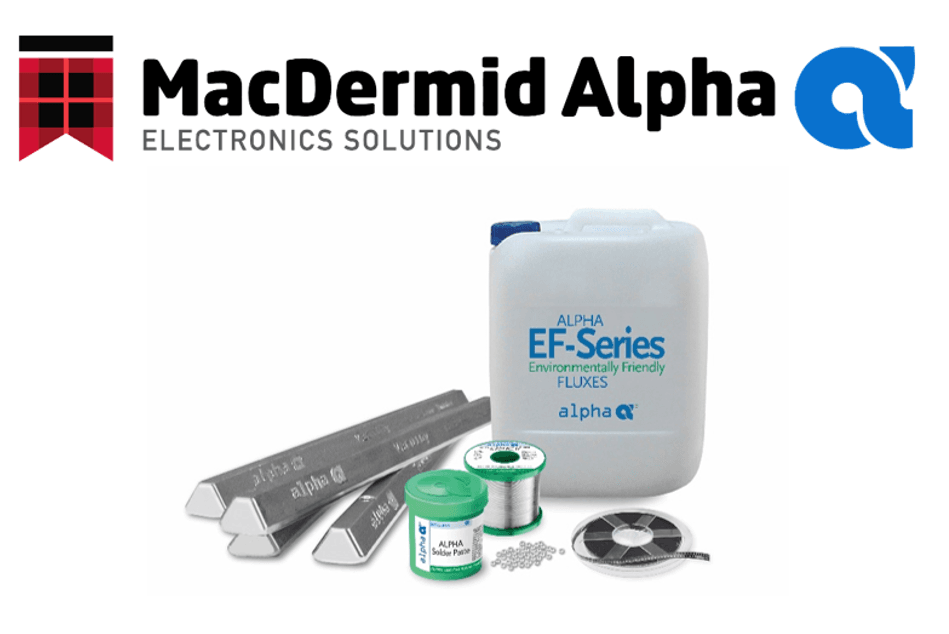
- As solder bar or solid wire: Alpha SnCX100, SACX Plus 0307, SACX Plus 0807
- As solder paste: Alpha CVP390, OM353, OM100
- As cored solder wire: Alpha HF-850, XL-825
For more information about MacDermid Alpha’s no-silver and low-silver solder alloys, please contact our sales.